
GP Summary Practice with Answers: A Worked Exercise (8881)
Good GP summary practice checks three things: whether you selected ideas that answer the question, preserved their meaning in your own words and stayed within the stated limit. A useful answer key should show where each idea came from, not merely provide a polished paragraph to copy.
This exercise gives you an original passage, a specific summary task and a complete suggested answer. Attempt it before reading the selection table. Then compare the meaning of your answer with the worked version, rather than counting how many identical phrases you used.
The passage, question and answer are original teaching material, not a past paper or an official mark scheme. The community programme is fictional. The 120-word limit belongs to this exercise; follow the limit printed on any actual question you attempt.
The practice task
Using paragraphs 2–4 only, summarise the benefits of borrowing tools from community centres and the difficulties associated with running or using these schemes. Write in your own words as far as possible. Use no more than 120 words.
The task has two parts: benefits and difficulties. Difficulties affecting borrowers and those affecting the centres are both relevant. The history in paragraph 1 is outside the specified range, however interesting it may be.
Under the 2026 General Paper 8881 syllabus, page 4, the summary is based on Passage 2 and carries eight content marks. The paper's 15 language marks are assessed through the summary and application responses. The selection table below is a teaching aid, not a list of officially awarded marks.
Original passage: borrowing instead of buying
Paragraph 1. The first tool cupboard at Bellfield Community Centre occupied a space once used for spare chairs. Its organisers expected little interest: borrowing a drill seemed less exciting than the sports and music activities advertised nearby. Within a year, however, the cupboard had become a small room. Residents donated equipment, volunteers painted shelves and a local artist designed a cheerful sign. Similar schemes appeared in neighbouring districts, each with its own rules and collection arrangements.
Paragraph 2. For households, the attraction is practical. Paying a small borrowing charge avoids the much larger expense of purchasing a tool that might be used only once or twice. Returning the equipment also frees space in crowded homes. Where borrowing genuinely replaces buying, fewer new products need to be manufactured and fewer unwanted ones eventually require disposal. Staff sometimes demonstrate simple repairs, enabling residents to keep damaged possessions in use. One borrower, for example, repaired a loose cupboard door instead of ordering a replacement cabinet.
Paragraph 3. Sharing nevertheless requires people to fit their plans around other borrowers. A popular item may already be on loan when someone needs it. Collection counters open for only a few hours can also be inaccessible to residents whose work or caring responsibilities fall at those times. Even an available tool is of little use if its weight or size makes carrying it home impractical without suitable transport. The publicity photograph of a smiling resident with a small screwdriver gives little sense of these complications.
Paragraph 4. Centres face difficulties of their own. Every returned item needs checking, and equipment requires maintenance to remain usable. Careless handling adds to the cost of repairs. Low borrowing fees keep the scheme affordable, but the money collected may be insufficient to replace damaged equipment. Some residents also need instruction before they can operate unfamiliar tools safely. Giving that guidance takes staff time, even when the eventual loan is brief. Enthusiasm for sharing cannot remove the work needed to make it function.
Check your point selection
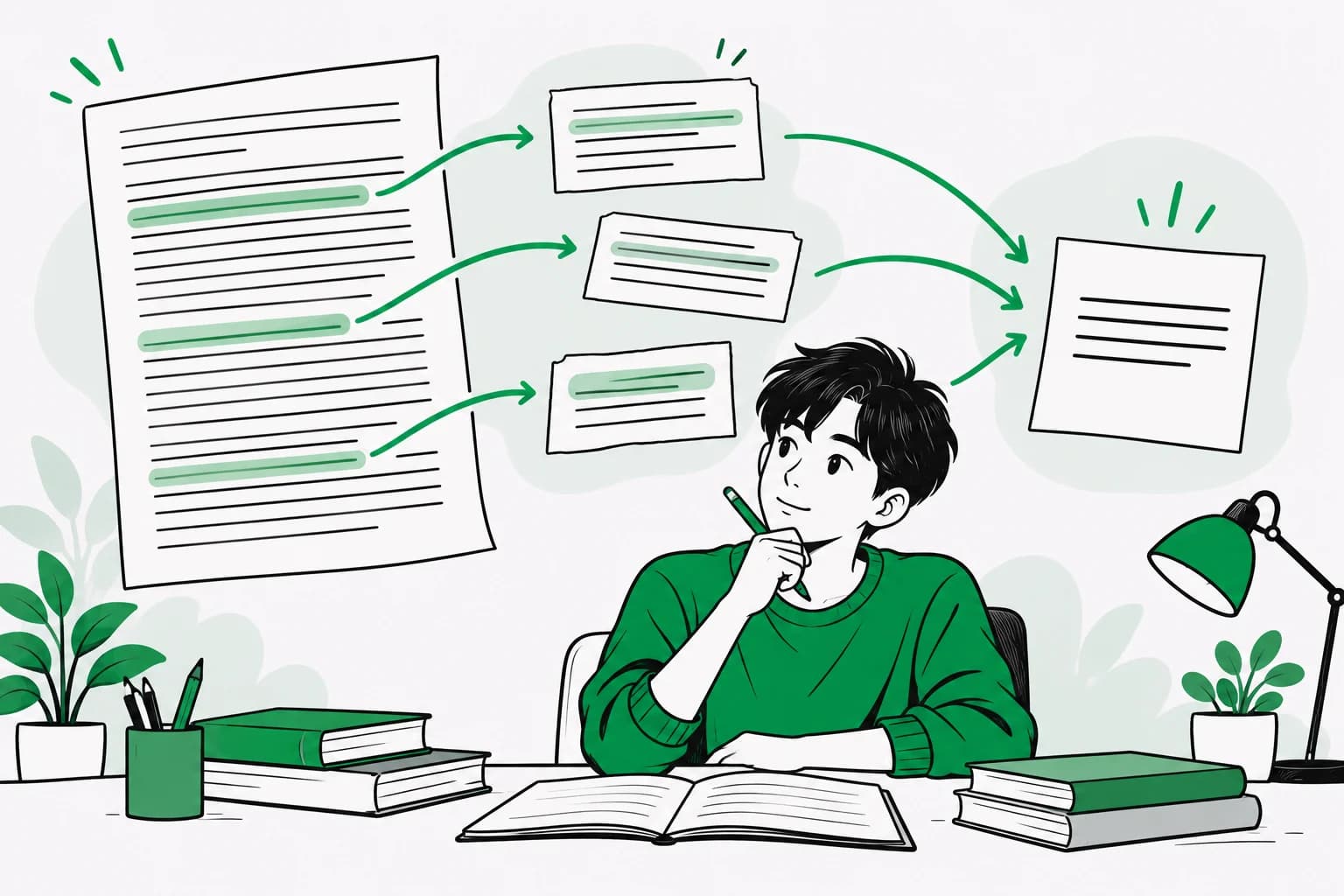
Before comparing sentences, compare the ideas you selected. The labels below help us discuss the answer; they do not imply one examination mark per row.
| Source | Relevant idea | What the answer must preserve |
|---|---|---|
| Paragraph 2 | Borrowing avoids an expensive purchase for occasional use. | The saving concerns equipment a household rarely needs. |
| Paragraph 2 | Returning tools reduces storage needs. | This is a separate benefit from saving money. |
| Paragraph 2 | Replacing purchases reduces production and eventual disposal. | The environmental benefit is conditional on borrowing replacing buying. |
| Paragraph 2 | Repair guidance helps residents keep possessions. | The cupboard example illustrates a wider benefit. |
| Paragraph 3 | Popular tools may already be borrowed. | Availability is limited at the time a user needs the item. |
| Paragraph 3 | Collection hours conflict with some schedules. | The problem is practical access, not lack of interest. |
| Paragraph 3 | Heavy or large tools can be difficult to transport. | Availability does not guarantee that the borrower can take the item home. |
| Paragraph 4 | Checking, maintenance and careless use create work and repair costs. | Include the centre's responsibilities, not only the borrower's inconvenience. |
| Paragraph 4 | Affordable fees may not cover replacement. | Low income is a possible constraint, not proof every scheme loses money. |
| Paragraph 4 | Safe use may require instruction and staff time. | Training has a purpose and a resource cost. |
The table separates meanings so that you can check them. Your final paragraph can combine related ideas without reproducing the table's structure. For example, checking equipment and maintaining it can share a clause, while cost and storage can share a sentence.
What should be left out?
The painted shelves, donated equipment and new sign belong to paragraph 1, which the question excludes. The publicity photograph in paragraph 3 adds colour but no further difficulty to summarise.
The cupboard repair is different. You should retain its underlying idea: guidance can help people repair possessions instead of replacing them. You can omit the particular cupboard and cabinet. Do not apply a mechanical rule that every example contains nothing relevant. Sometimes an example is where a useful idea becomes clear; identify that idea before deciding what to cut.
A complete suggested summary
Borrowing seldom used tools saves households money and storage space. When loans replace purchases, fewer products need to be made and discarded. Guidance can help residents repair belongings instead of replacing them. However, popular equipment may be unavailable, while collection hours can exclude those whose schedules conflict. Moving large or heavy tools is difficult for residents without suitable transport. Centres must inspect and maintain equipment, and careless use increases repair costs. Keeping fees affordable may leave too little income to replace damaged tools. Borrowers may also need instruction before they can use equipment safely, which takes staff time.
Word count: 98 words. This counts each space-separated word in the answer above; punctuation does not add words. The answer stays below this exercise's 120-word limit. There is no need to fill every remaining word if the required ideas are clear.
This is one possible answer. A different order or wording can work if it conveys the relevant meanings accurately. The answer has not been awarded a mark, and matching it word for word is not the aim of the exercise.
How the answer compresses the passage
It groups without merging distinct ideas
“Money and storage space” combines two benefits economically while keeping both recognisable. By contrast, “borrowing is convenient” would blur several different ideas and leave the reader guessing what the convenience consists of.
The final two sentences also distinguish replacement costs from training time. Both concern running the scheme, but they are not interchangeable. Compression should remove unnecessary wording, not erase a relevant distinction.
It keeps the condition attached to the environmental benefit
The passage says fewer products need to be made where borrowing replaces buying. The answer keeps that condition. “Borrowing tools always reduces waste” would be stronger than the source: a person might borrow something they would otherwise never have bought.
Qualifiers can look expendable when you are cutting words. Often they are the words protecting the accuracy of the point. Keep “may”, “some” or a condition when deleting it would change the claim.
It changes expressions without changing causes
The passage describes a collection counter whose hours clash with work or caring duties. The answer refers to “those whose schedules conflict”. That saves the list while preserving why access is difficult.
“People dislike the opening hours” would change a practical barrier into a preference. “Centres refuse to serve workers” would invent a motive. An accurate paraphrase needs the same relationship between circumstances and outcome, even when its vocabulary is different.
Three weaker answers to repair
| Weaker wording | What goes wrong | A more precise revision |
|---|---|---|
| “Tool sharing is cheaper and better for everyone.” | “Everyone” is unsupported, and the environmental condition disappears. | “Borrowing saves occasional users purchase costs; when it replaces buying, production and disposal can fall.” |
| “The programme fails because residents damage everything.” | The passage describes a risk and added costs, not universal damage or failure. | “Careless handling raises repair costs.” |
| “Centres need more volunteers.” | This may sound like a sensible solution, but the task asks for the writer's benefits and difficulties. | “Instruction takes staff time.” |
The third error is especially easy to miss. A summary reports the source's relevant ideas. It does not ask you to solve the problem or add your own evaluation. Keep those skills for tasks that request them, such as the GP Application Question.
Try a shorter selection drill
Use the same passage, but change the task:
Using paragraph 3 only, summarise the difficulties borrowers may face. Use no more than 40 words.
This time, benefits and the centre's maintenance costs are outside the scope. Write your answer before opening the suggestion.
Show a suggested answer
Popular tools may be unavailable when needed. Collection hours can clash with borrowers' other commitments, and transporting large or heavy equipment is difficult without a suitable means of carrying it.
This answer contains 30 space-separated words. It retains all three difficulties from paragraph 3 without adding the photograph, advice about better opening hours or information from another paragraph.
A shorter limit does not justify answering a different question. Start by narrowing the selected material to the specified paragraph and focus. Only then shorten the wording.
Review your attempt before doing another passage
Use three separate passes. First, check selection: highlight each idea in your answer and locate its source. Next, check meaning: circle any claim that is stronger, broader or more certain than the passage. Finally, check expression: look for copied explanatory phrases, unnecessary repetition and unclear sentences.
If your answer is over the limit, do not begin by deleting the last sentence. It may contain the only reference to staff time. Remove repetition or decorative wording first, then combine compatible points. Read the result aloud to check that it remains a coherent paragraph.
Our step-by-step GP summary guide explains the wider method. If understanding the underlying sentence is difficult, start with the short-answer worked examples. When you are ready to practise across a paper, follow the Paper 2 online practice guide.
Frequently asked questions
How should I use GP summary practice answers?
Attempt the task first, then compare selected meanings, qualifications and word count. Use the suggested answer to diagnose omissions or distortions. Copying its wording repeatedly does not show whether you can select and express ideas independently.
Is 120 words the limit for every GP summary?
No universal limit is being asserted here. This original exercise sets 120 words. Read and follow the instruction on your actual question instead of relying on a number memorised from a practice article.
Must my summary use all the words available?
No. The limit is a ceiling for this task, not a target to fill. If relevant ideas are missing, add them clearly; if the answer already covers the task accurately, extra words may only create repetition.
Should I always remove examples from a GP summary?
Check what the example contributes. You can often omit its names and incidental details while retaining the underlying idea that answers the question. Removing every example automatically can cause you to miss a relevant meaning.
Ready to put these tips into practice?
Practise GP Paper 2, review available suggested answers and use feedback to improve your next attempt.
Related articles
GP Paper 2 Time Management: A 90-Minute Plan (8881)
Plan GP Paper 2 with an exact 90-minute timetable, AQ checkpoints and recovery options. Learn how to adjust your timing through practice for General Paper 8881.
GP AQ Sample Answer: Annotated Singapore Response (8881)
Study a complete GP AQ sample answer on digital services in Singapore, with original passages, paragraph annotations and evidence checks for Paper 2.
GP Paper 2 Comparison Questions: A Worked Guide (8881)
Learn GP Paper 2 comparison questions with original passages and worked answers showing how evidence supports, undermines or qualifies another writer's claim.