
How to Write a GP Summary: A Step-by-Step Method for Paper 2
Ask a JC2 student which Paper 2 question they find most frustrating and many will say the summary. It looks small. It is only eight marks and a short paragraph. Yet it eats time, and students walk out unsure why they lost marks.
The reason is simple. A summary is not a shorter version of the passage. It is a selection task and a rewording task done together, under a strict word limit. Once you treat it that way, it becomes one of the most trainable questions on the paper.
This guide gives you a six-step method, a worked example, and the mistakes that cost marks most often.
What the GP summary tests
Under the H1 General Paper 8881 syllabus, the summary is based on Passage 2 and is worth 8 content marks. Your writing in the summary, together with your Application Question answer, also determines the paper's 15 language marks. Our guide to the GP Application Question shows the full mark split.
That means the summary tests three things at once:
- Selection: can you find the points that answer the question and leave out the rest?
- Own words: can you express those points in your own language rather than copying?
- Control: can you write one clear, accurate, well-organised piece within the word limit?
A student who lists everything in the passage fails the first test. A student who copies sentences fails the second. A student who writes a rambling paragraph fails the third.
The six-step method
Step 1: Read the question stem before the passage
The summary question tells you exactly what to summarise. It usually points to one idea in the passage, such as the causes of a problem, the benefits of a policy, or the writer's concerns about a trend. Underline the focus words and write them at the top of your page.
If you skip this step, you will read the passage with no filter and end up summarising all of it.
Step 2: Mark the relevant points in the passage
Read the passage once with a pencil. Mark only the ideas that answer the question. A relevant point is usually a claim or reason, not an illustration.
Skip the following:
- Examples and anecdotes: "For instance, a teacher in Ohio..."
- Repetition: the same idea said a second time in different words
- Rhetorical flourish: metaphors and decorative phrases
- Opinions that do not answer the question
Step 3: List your points in short note form
Write each point in four to eight words, in your own shorthand. Do this on scrap paper or the margin, not in full sentences.
Passage: "Because workers now check email at all hours, the boundary between office and home has dissolved, leaving many unable to rest properly."
Note: always online, no rest
Writing in note form forces you to understand the idea instead of copying its phrasing. It also helps you spot two points that are really the same.
Step 4: Group and order your points
Look at your list. Which points belong together? Combine them under a shared idea, then decide on an order that makes sense: causes before effects, or the most important point first.
This is where many summaries gain a language mark. A grouped summary reads as one thought. A listed summary reads as a copy of the passage.
Step 5: Write one paragraph in your own words
Now write the summary from your notes, not from the passage. Keep the following in mind:
- Change the structure, not just the words. Replacing "workers" with "employees" is not paraphrasing. Reorder the clause, or turn a verb into a noun.
- Keep technical terms that have no real substitute. You cannot paraphrase "climate change" or "inflation" without sounding odd.
- Join your points with logical links such as "as a result," "which in turn," and "while." Avoid starting every sentence with "The writer says."
- Write complete, accurate sentences. Grammar and punctuation count towards your language mark.
Step 6: Count and trim
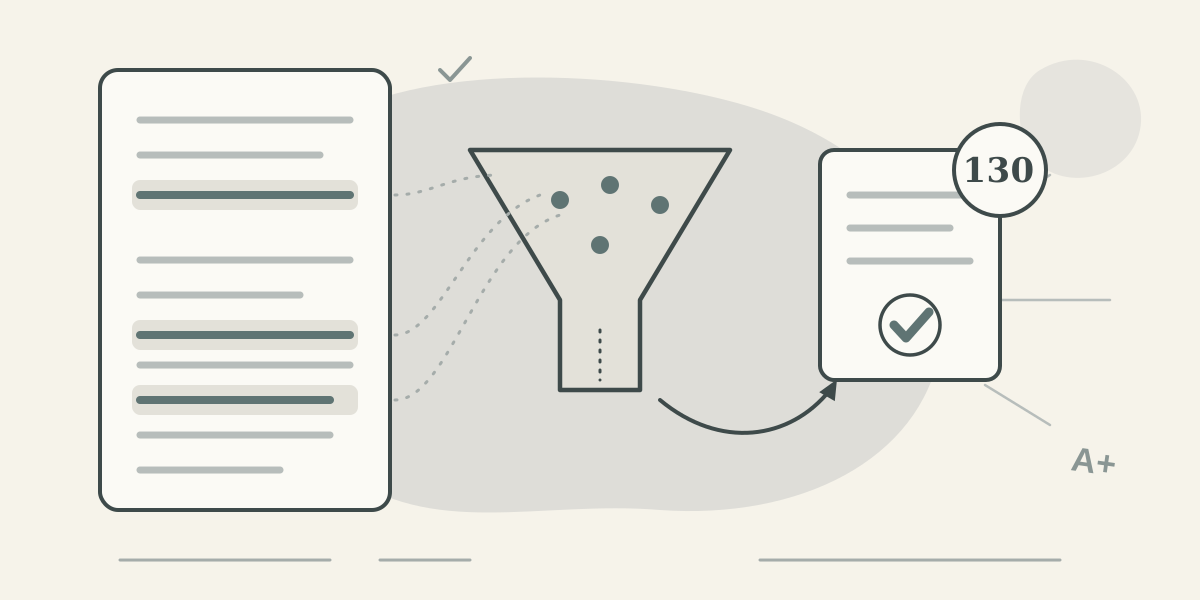
Check the word limit stated in the question. In the current format it is around 130 words. Treat it as a hard ceiling. Count your words, then trim: cut adjectives, merge sentences, and remove anything that repeats an idea you already made.
Do not count on the examiner being generous. Content beyond the limit is typically not credited.
A short worked example
Here is an invented practice passage (not from a real paper) and a summary question.
Passage excerpt: "Remote work has transformed how many people earn a living. Staff save hours previously lost in traffic, and many report greater control over their schedule. Companies, meanwhile, have found they can recruit from a wider pool of talent. Yet the arrangement is not without cost. For instance, one manager recalled how a junior colleague felt too anxious to ask questions in a chat window. Many employees also say they struggle to switch off, as the home becomes the office. Isolation, too, has grown as casual conversations in corridors have disappeared."
Question: Summarise the benefits and drawbacks of remote work, according to the writer.
Notes:
| Benefits | Drawbacks |
|---|---|
| save commuting time | hard to switch off |
| control over schedule | isolation, no casual chats |
| firms recruit more widely |
The example about the junior colleague is an illustration, so we leave it out.
Sample summary:
Remote work gives employees back commuting time and more control over their schedules, while allowing firms to hire from a broader pool of talent. However, it blurs the line between work and home, making it difficult to rest, and reduces the casual interaction that once connected colleagues, which can leave people isolated.
Notice what this does. It groups benefits and drawbacks, it uses "however" to signal the shift, and it rephrases rather than copies ("switch off" becomes "rest," "disappeared" becomes "reduces").
The most common summary mistakes
| Mistake | Why it costs marks | Fix |
|---|---|---|
| Copying whole phrases | No credit for own words | Write from your notes, not the passage |
| Including examples | Examples are not the points | Cross out illustrations in Step 2 |
| Adding your own opinion | The summary is about the writer's ideas | Report, do not evaluate |
| Exceeding the word limit | Extra content may not be credited | Count and trim |
| Listing points as bullets | Lowers language quality | Write one connected paragraph |
| Misreading the question | Points answer the wrong thing | Underline the focus words first |
Time and practice
Plan roughly 15 to 20 minutes for the summary, depending on how you split the paper. Our GP comprehension guide has a full timing plan for Paper 2. For wider language habits, see our guide to improving your GP language marks.
A simple weekly drill works well:
- Take one editorial of about 500 words.
- Write a question that asks for a specific focus.
- Complete steps 1 to 6 in 20 minutes.
- Compare your points with a classmate or tutor.
Key takeaways
- The summary is worth 8 content marks and also shapes your Paper 2 language score.
- Read the question stem first, so you know what you are selecting.
- Mark claims and reasons; skip examples, repetition and decoration.
- Write from short notes, not from the passage, to force your own words.
- Group points and join them with logical links so it reads as one paragraph.
- Count your words and trim to stay within the limit.
See how your essays measure up
Get detailed feedback on your A-Level essays in under 45 seconds. Free to start — no credit card required.
Frequently Asked Questions
How many marks is the GP summary worth?
Under the H1 General Paper 8881 syllabus, the summary is worth 8 content marks, based on Passage 2. Your summary writing, together with the Application Question, also contributes to the paper's 15 language marks.
Do I need to use my own words in a GP summary?
Yes. Examiners reward points expressed in your own words. Lifting long phrases from the passage can lose credit. Keep technical terms that have no natural substitute, but rephrase the surrounding structure.
Should I include examples from the passage in my summary?
Usually no. Examples and anecdotes illustrate a point rather than being the point. Focus on the underlying claim or reason, and use your limited words on those.
Is it better to write in bullet points or a paragraph?
A single connected paragraph is the safer choice. Bullet points make it hard to show control of sentence structure and linking, both of which matter for language marks.
What happens if I go over the word limit?
Content beyond the stated limit is typically not credited, so you may lose points that appear at the end of your answer. Count your words and trim the less important ideas rather than the key ones.
Ready to put these tips into practice?
Submit your essay and get examiner-grade AO feedback in 90 seconds.
Related articles

How to Improve Your GP Essay Language Marks: A Practical Guide
Twenty of your fifty Paper 1 marks come from language. Learn what examiners look for in vocabulary, sentence variety and accuracy, and the habits that lift your language score.

How to Answer the GP Application Question (AQ): 8881 Guide
The GP Application Question is worth 12 marks and much of your Paper 2 language score. Learn a step-by-step method, a model AQ paragraph, and the mistakes to avoid.
GP Essay Global Examples Beyond Singapore: A Complete 2026 Guide
A comprehensive collection of non-Singapore examples organized by GP themes, featuring recent case studies from underrepresented regions worldwide.