
GP Paper 2 Time Management: A 90-Minute Plan (8881)
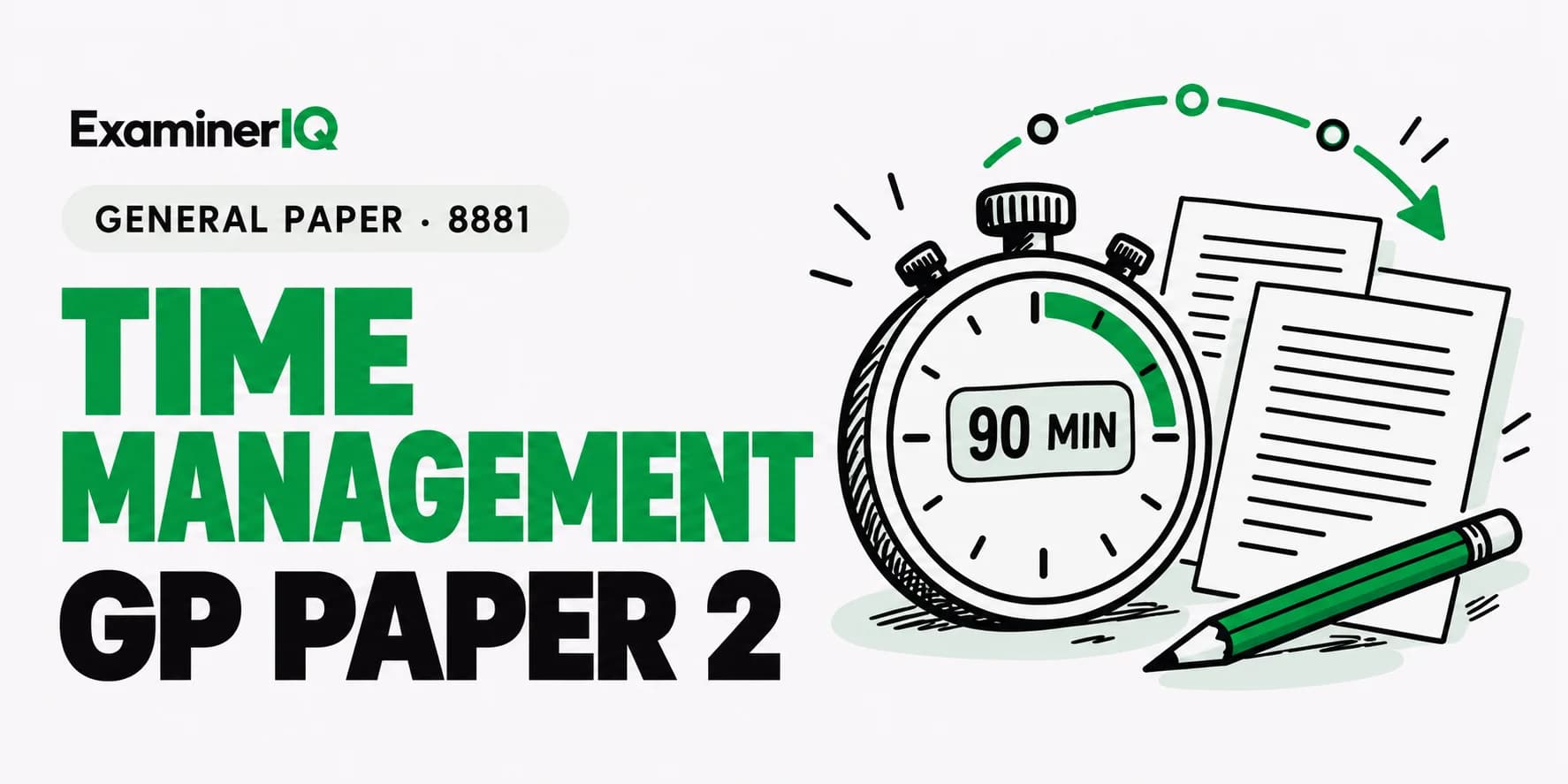
A practical GP Paper 2 time management plan reserves time for every task before you begin: 10 minutes for reading, 22 for short answers, 18 for summary, 8 for connections, 27 for the AQ and 5 for a final check. That totals 90 minutes, including reading and planning. Use it as a starting point, then adjust it using evidence from timed practice.
The familiar problem is reaching the AQ with too little time to develop an answer. Often, no single earlier question caused the problem. A longer reread, an unnecessary rewrite and a few extra sentences gradually consumed the time intended for the final response. Checkpoints help you notice that drift while you can still act on it.
A GP Paper 2 time allocation that adds up to 90 minutes
The 2026 SEAB General Paper 8881 syllabus, page 4 gives Paper 2 90 minutes. It assigns 12 content marks to the AQ and 8 to the summary; the 15 language marks are assessed through those two responses. It does not prescribe minutes for individual sections.
The timetable below is our suggested practice allocation, not an official SEAB timing rule. “Elapsed time” means minutes since you started. It does not assume a particular examination start time. The order is an example; follow the paper's instructions and rehearse any different sequence before relying on it.
| Task | Minutes | Elapsed time |
|---|---|---|
| Read questions and passages | 10 | 0–10 |
| Short-answer questions | 22 | 10–32 |
| Summary | 18 | 32–50 |
| Connections across passages | 8 | 50–58 |
| Application Question, including planning | 27 | 58–85 |
| Final check | 5 | 85–90 |
| Total | 90 | Finish at minute 90 |
Keep the checkpoint numbers visible during practice: 10, 32, 50, 58 and 85. If you change the order, recalculate the checkpoints. Keeping the same labels after moving tasks around makes the plan harder to follow.
What to do inside each time block
Reading: establish a map of the passages
Use the first ten minutes to understand the questions, the writers' main claims and the relationships between the passages. Brief notes such as “benefit”, “objection” or “condition” can help you find an idea again. Mark possible material for the longer responses without drafting them in the margin.
This is an initial reading allocation. You will return to relevant lines while answering questions; those targeted rereads belong inside the later task budgets. The aim is to avoid repeatedly rereading whole passages because you have lost track of their arguments.
Short answers: decide whether another minute has a purpose
For each answer, identify the task, locate the evidence and state the required meaning. Before adding another sentence, check what it contributes. Repeating a point in more elaborate language uses time without necessarily making the answer clearer.
If you are stuck, make a visible reminder to return and move to another required task. Aim to attempt every question. Moving on temporarily should create a return plan, rather than make an unanswered question disappear from your attention. Our short-answer worked examples show how to distinguish precise explanation from unnecessary elaboration.
Summary: include selection and checking in the budget
The eighteen minutes must cover identifying relevant points, drafting and checking the answer against the stated limit. A possible practice split is 3 minutes selecting, 13 writing and 2 checking. Test that split rather than treating it as a requirement.
Avoid writing an overlong version on the assumption that you will find spare time to cut it later. Select against the question's focus before drafting. Our complete summary practice exercise lets you compare your selection with a worked answer.
Connections: explain the relationship directly
Read the specified claim and passage references carefully. Find relevant evidence, then explain why it supports, challenges or limits the claim. Two lengthy passage summaries can consume the block without making the connection explicit.
Use the comparison questions guide to practise that final explanation. The eight-minute allocation is a starting budget for this task group, not a rule about how long any individual question deserves.
AQ: plan within the protected block
The suggested 27 minutes already includes planning. One way to practise is 3 minutes planning, 22 writing and 2 checking relevance. Do not add another planning block outside the timetable without taking the time from somewhere else.
A brief plan can identify the passage claims, your judgement, relevant evidence and the reasoning connecting them. Then write a developed response to the actual task. The annotated AQ sample answer shows what that reasoning looks like; its word count is not a target to reproduce at speed.
Final check: use a short priority list
Check for unanswered questions first. Then inspect the summary's focus and word limit, the AQ's engagement with the question, and unclear or incorrect expression in both longer responses. Correct errors that obscure meaning before polishing an already clear sentence.
Clear short answers still matter, even though they do not contribute to the separate language score. The distinction helps you understand the assessment; it does not justify leaving them incomplete or unreadable.
How to adjust the plan to your own pace
A useful adjustment names both where the extra minutes go and where they come from. “I need five more minutes to read” is only half a plan.
For example, if practice shows that a more careful first reading reduces your later searching, you could test 15 minutes reading, 20 short answers, 15 summary, 8 connections, 27 AQ and 5 checking. This still totals 90. The additional five reading minutes come from two short-answer minutes and three summary minutes.
That trade is sensible only if you can complete those tasks adequately in their smaller budgets. If your summary already overruns, taking three minutes from it may simply move the problem. Try the revised allocation on an unfamiliar paper and compare the quality and completeness of the responses, not just the finishing time.
Keep one change at a time. Otherwise, if a practice attempt improves, you will not know whether the benefit came from a better first reading, a different order or shorter answers.
What to do when you are behind schedule
At each checkpoint, look at both the clock and the unfinished work. Being three minutes late with one nearly complete answer is different from having several questions untouched. Avoid assuming that the original timetable can continue unchanged after a substantial overrun.
If the AQ has not started by minute 65
There are 25 minutes left. If all other required answers are complete, one recovery option is 3 minutes planning the AQ, 19 writing and 3 checking. Those three checking minutes replace the original final-check allocation; they are not followed by another five minutes.
Keep the response focused on the specified ideas. A shorter explanation that develops relevant evidence is more useful than a long introduction followed by unfinished evaluation. Do not invent examples to save thinking time or force a memorised paragraph into an unsuitable question.
If other answers remain unfinished, list them briefly and decide how to share the remaining time. You cannot reserve all 25 minutes for the AQ and also assume those questions will be answered later. Consider which incomplete responses you can still develop meaningfully, while preserving time for a coherent AQ. There is no universal emergency split that fits every pattern of missing work.
If one short answer is holding up everything else
Identify what is missing: locating evidence, understanding a phrase or expressing an idea. If another reread has produced no progress, leave a return marker and continue. When you return, address that specific difficulty instead of starting the same search again.
The decision is about the remaining paper, not about declaring a question unimportant. A fixed “minutes per mark” formula cannot account for different reading demands or the work you have already completed.
Use three practice attempts to diagnose the problem
Record timing during practice without turning every sentence into a stopwatch exercise. Note the elapsed time when you finish each task group. Afterwards, compare it with the planned checkpoint and identify what consumed the difference.
Use these prompts in a notebook or revision document:
| What to record | Useful detail |
|---|---|
| Planned and actual checkpoint | “Summary planned to finish at 50; finished at 56.” |
| Work still unfinished | Name the task or question rather than writing “behind”. |
| Main source of delay | Searching, understanding, planning, writing or rewriting. |
| Quality after review | Missing ideas, unclear explanation or unnecessary repetition. |
| One change to test | A specific action with an explicit time trade-off. |
Attempt 1: establish your pattern. Use the baseline and record where time went. Do not interpret one difficult passage as proof that the entire allocation is wrong.
Attempt 2: test one change. If rereading caused the delay, try a clearer passage map. If overwriting caused it, practise answering the exact question more directly. If a particular skill is weak, work on that skill before simply demanding a faster response.
Attempt 3: check transfer. Use another unfamiliar paper. A plan that works only when you already know the passage is not yet a dependable examination routine. Look for both more consistent timing and answers that still address their tasks.
Our Paper 2 online practice guide explains how to organise attempts and review available feedback. For a wider diagnosis of comprehension skills, see the JC2 comprehension guide.
Frequently asked questions
How much time should I spend on the GP AQ?
This practice plan reserves 27 minutes, including planning and a brief relevance check. Treat that as a starting allocation. If you need longer, identify which other task can use less time without leaving required work unfinished.
Should I do the AQ first in Paper 2?
You can test a different order during practice, subject to the paper's instructions. Read enough to understand the required passage ideas before answering. Move whole time blocks and recalculate checkpoints; doing the AQ first does not create extra time for the other tasks.
Does the 90-minute plan include reading and planning?
Yes. The first ten minutes covers the initial reading. Targeted rereading happens inside the relevant task budgets, and AQ planning is included in its 27-minute block. The final five-minute check is also part of the total.
What should I do if I keep running out of time for GP Paper 2?
Record when you finish each task, then distinguish slow understanding from unnecessary writing or repeated searching. Test one targeted change on another paper. Finishing faster is not an improvement if relevant ideas or required answers disappear.
Is this the official SEAB time allocation for each section?
No. The section budgets are suggested practice choices. Use them to build and test a plan for the allotted paper duration, while following the instructions on your actual paper.
Ready to put these tips into practice?
Practise GP Paper 2, review available suggested answers and use feedback to improve your next attempt.
Related articles
GP AQ Sample Answer: Annotated Singapore Response (8881)
Study a complete GP AQ sample answer on digital services in Singapore, with original passages, paragraph annotations and evidence checks for Paper 2.
GP Summary Practice with Answers: A Worked Exercise (8881)
Try an original GP summary practice passage, then check a complete answer, point selection, paraphrasing and word count for General Paper 8881 Paper 2.
GP Paper 2 Comparison Questions: A Worked Guide (8881)
Learn GP Paper 2 comparison questions with original passages and worked answers showing how evidence supports, undermines or qualifies another writer's claim.