
GP Model Essay: A Band 5 Essay Annotated Paragraph by Paragraph (8881)
A useful GP model essay lets you see the decisions behind the writing. Why does the introduction qualify its position? What turns an example into evidence? How can a counter-argument change the discussion without overturning the thesis?
This guide answers those questions through a complete essay on technology and decision-making. Read the quoted paragraphs in sequence, or pause at the annotations to examine each move.
This is an original teaching example designed to illustrate Band 5 qualities. It has not been examiner-marked, is not an official model answer, and does not carry a guaranteed score. The question is an original practice question, not a past-year examination question. The six essay paragraphs contain 709 words; headings and teaching notes are excluded.
Before you read: the question and plan
Practice question: To what extent should we trust technology to make decisions for us?
The phrase “to what extent” requires a judgement about degree and conditions. An essay that lists technological benefits and dangers without deciding when trust is justified only partly addresses that task.
The 2026 SEAB 8881 syllabus assesses content and language separately. Band 5 covers 25 to 30 marks for content and 17 to 20 for language, with an essay length of 500 to 800 words. These are assessment ranges, not marks awarded to this example. See our band descriptors guide for a fuller explanation.
| What to notice | How the essay approaches it |
|---|---|
| Scope | It focuses on computational decision-making, rather than every invention called “technology”. |
| Position | Trust is justified to different degrees depending on reliability, consequences and accountability. |
| Development | Each example is followed by an explanation of what it establishes and what it cannot establish. |
| Balance | The strongest objection, that humans also make poor decisions, changes the standard used to judge technology. |
| Language | Qualifications and precise verbs carry the argument; complicated vocabulary is not the main attraction. |
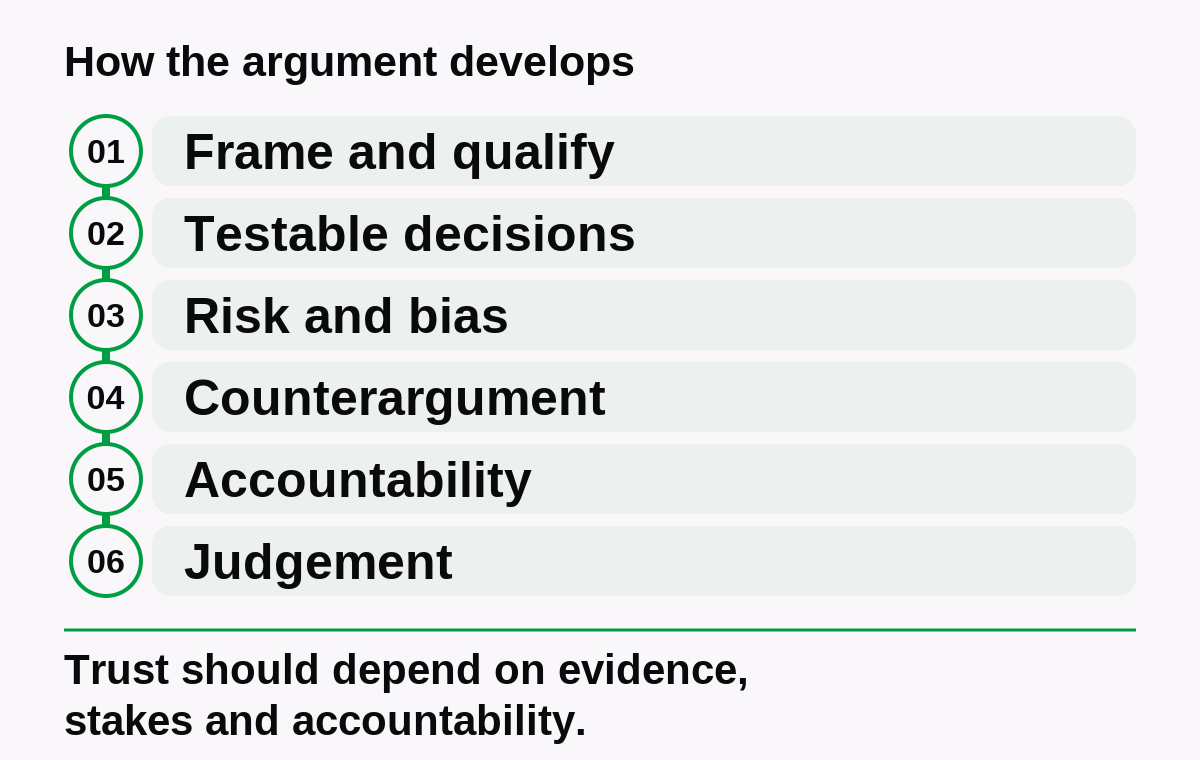
The route is deliberate: frame the distinction → justify testable decisions → examine risk and bias → confront human fallibility → establish accountability → judge the extent of trust. Each paragraph adds a condition to the thesis instead of repeating “technology has advantages and disadvantages”.
1. Introduction: define the real disagreement
Technology already helps us choose routes, identify promising research and assess strangers. Its growing influence makes trust unavoidable, but trust need not mean surrender. In this discussion, trusting technology means allowing computational systems to shape or take decisions that people would otherwise make themselves. The crucial distinction is between relying on a system's useful findings and accepting its authority without challenge. We should delegate extensively where objectives are clear, performance can be checked and mistakes can be corrected. Where decisions determine people's opportunities or rights, however, technological competence must be accompanied by human accountability. The proper extent of trust depends on the decision, not simply on how advanced the technology appears.
Why this paragraph works
Content: “Relying on a system's useful findings” and “accepting its authority without challenge” separate assistance from unquestioned authority. This gives the essay something more precise to debate than whether technology is good. The thesis then supplies criteria: clear objectives, verifiable performance, correctable mistakes and accountability. Those criteria will organise the body paragraphs.
Language: “We should delegate extensively where...” expresses a position and a limit in the same sentence. The following “Where...” sentence changes the context from manageable tasks to decisions affecting rights. This is controlled variation with an argumentative purpose.
Common trap: Opening with “Since the dawn of time, technology has changed society” spends words on history without resolving the question's terms.
Transferable technique: Define a distinction that changes your answer, then state the conditions under which your position holds. Elsewhere, the distinction might be access versus equality, or freedom versus absence of responsibility.
2. Body paragraph: show when trust is justified
Consider first decisions whose success can be tested against a relatively clear objective. A navigation system can compare possible journeys using more information than a driver can readily process, making reliance on its recommendation reasonable. Similarly, AlphaFold's predictions of protein structures give researchers a powerful starting point for deciding which scientific possibilities to investigate. Neither example requires us to believe that technology is infallible. A driver can check an unsuitable route, while researchers must investigate what a predicted structure actually implies. Their value lies in narrowing choices and directing limited attention towards promising options. Trust is therefore justified by a productive division of labour: technology processes information, while people examine whether its output fits the situation. This case is strongest when errors are detectable and correction remains possible before serious damage occurs.
Why this paragraph works
Content: The topic sentence supplies a criterion, “a relatively clear objective”, before introducing examples. Navigation and protein research differ in complexity, but both support the same mechanism: processing information helps people narrow their choices. “A powerful starting point” carefully limits the AlphaFold claim. Predicting a structure does not establish a treatment's safety or replace clinical judgement.
Language: “Similarly” connects two examples through a shared function. The colon in “division of labour:” introduces an explanation, while “strongest when” turns a general benefit into a conditional judgement. The final sentence tells us how far the examples support trust.
Common trap: Naming a famous invention and adding “This proves technology is beneficial”. An example needs a bridge to the exact claim being argued.
Transferable technique: Use the sequence example → mechanism → limit → implication for the question. Explain the first example before adding another.
Evidence note: EMBL-EBI explains AlphaFold's predicted structures and how to interpret prediction confidence. The decision-making argument applies that capability to research; it does not suggest independent medical decision-making.
3. Body paragraph: evaluate risk and unequal errors
The same confidence becomes harder to justify when a wrong decision can restrict someone's freedom or livelihood. A 2019 study by the United States National Institute of Standards and Technology found demographic differences in the performance of many facial recognition algorithms, although results varied considerably across systems. This matters because a mistaken match could direct suspicion towards an innocent person if treated as decisive evidence. The issue is not merely that machines sometimes fail; humans do too. It is that an apparently objective output may discourage scrutiny while distributing errors unevenly. Consequently, even impressive overall accuracy cannot by itself justify delegating a consequential decision. Those affected need safeguards appropriate to the harm, including independent checks and a practical way to contest the result.
Why this paragraph works
Content: “The same confidence” connects this paragraph to the previous one. The variable that changes is the consequence of error. “Although results varied considerably across systems” prevents the evidence becoming a blanket claim about every facial recognition tool. The reasoning then distinguishes average accuracy from how errors affect particular people.
Language: “Could” and “if treated as decisive evidence” describe a possible consequence rather than inventing a documented incident. The short sentence “humans do too” anticipates the objection developed next. “Cannot by itself justify” is stronger and more defensible than claiming accuracy is irrelevant.
Common trap: Treating one study as proof that all AI is biased, or discussing discrimination without explaining its bearing on trust.
Transferable technique: Ask who bears the cost when an apparently beneficial system fails. Then explain why that distribution changes the degree of trust you would permit.
Evidence note: NIST's 2019 report summary explains both the demographic differences and the variation between algorithms. The hypothetical consequence in the essay is reasoning from the finding, not a case reported by the study.
4. Body paragraph: take the strongest objection seriously
Nevertheless, requiring human control everywhere could preserve the very weaknesses technology helps us overcome. People become tired, apply standards inconsistently and bring prejudices to decisions about others. A carefully tested system may sometimes offer more reliable judgement than the available human alternative, particularly when decisions are repetitive and evidence is abundant. Rejecting it because it is imperfect would demand a standard we rarely meet ourselves. Yet this objection supports comparative testing, not unconditional delegation. A system should earn greater authority by demonstrating better performance in its intended setting, including for groups who might otherwise bear disproportionate costs. Human oversight must also be meaningful: a reviewer needs time, relevant expertise and the power to disagree. A hurried signature on an automated recommendation offers little protection.
Why this paragraph works
Content: The objection challenges a possible weakness in the essay's own position: human control does not automatically improve a decision. “The available human alternative” establishes the right comparison. The rebuttal accepts this objection's force, then explains what follows: comparative testing and oversight with actual power. It refines the thesis instead of pretending the objection has vanished.
Language: “May sometimes” preserves the possibility of technological superiority without asserting it universally. “Yet this objection supports...” turns from concession to judgement. The concrete final image, “a hurried signature”, makes an abstract concern about ineffective oversight easy to grasp.
Common trap: Giving an opponent an absurd claim, such as “machines never make mistakes”. A useful counter-argument creates a real difficulty for your position.
Transferable technique: Ask, “If a thoughtful critic were right about this, what would I need to change?” For more practice, see our guide to counter-argument and rebuttal.
5. Body paragraph: turn caution into accountability
Trust must therefore be built through institutions as well as technical improvements. Singapore's AI Verify initiative provides a framework and toolkit for testing AI systems, illustrating an attempt to make responsible use more concrete. Such testing can inform confidence, but it cannot guarantee fairness or settle every disagreement about what a decision should achieve. A hiring tool might predict retention accurately while disadvantaging applicants whose circumstances differ from those of previous employees. Deciding whether that trade-off is acceptable requires a defensible policy, not merely a better prediction. Organisations using such tools should explain their purposes, monitor outcomes and remain answerable when things go wrong. In high-stakes contexts, people should delegate analytical work without allowing responsibility for the resulting decision to disappear behind the software.
Why this paragraph works
Content: “Therefore” signals a conclusion drawn from the earlier discussion, rather than a new item in a list. AI Verify illustrates a response to the problem of trust. The next sentence limits its significance: testing does not settle questions of values. The hypothetical hiring example explains why prediction and a defensible decision are different achievements.
Language: “Might predict” clearly marks the hiring scenario as hypothetical. The parallel verbs “explain”, “monitor” and “remain answerable” translate accountability into concrete actions. The closing sentence returns to the introduction's distinction between assistance and authority.
Common trap: Adding a Singapore example for local relevance without showing its function, or describing a testing framework as proof that a system is fair.
Transferable technique: Once you identify a limitation, show what a credible response would require and why it would help. A solution paragraph earns its place through reasoning, not the phrase “the government should do more”.
Evidence note: IMDA's AI Verify announcement describes technical tests and process checks. The essay treats testing as evidence to inform trust, not a guarantee of fairness.
6. Conclusion: decide how far the argument holds
We should thus trust technology substantially, but conditionally. The strongest case for delegation concerns tasks with clear goals, demonstrated reliability and consequences that can be checked and corrected. Greater uncertainty, disputed values and more serious harm demand stronger scrutiny and clearer responsibility. Crucially, human involvement is valuable only when it can improve or challenge the decision; it should not become an empty ritual. The question is therefore how much authority a particular system has earned in a particular setting. Technology deserves room to assist and sometimes decide, but never the power to make accountability optional.
Why this paragraph works
Content: “Substantially, but conditionally” answers the degree demanded by “to what extent”. The next sentences identify conditions that increase or reduce justified trust. The conclusion also incorporates the counter-argument: human involvement matters only when it does useful work. This prevents the ending from retreating into a simplistic demand for human control.
Language: “Greater uncertainty, disputed values and more serious harm” creates a parallel sequence of reasons for caution. “A particular system” and “a particular setting” keep the judgement specific. The final sentence is memorable because its claim follows from the essay.
Common trap: Ending with “There are two sides, so we must strike a balance”. That leaves the reader to work out what balance means.
Transferable technique: Finish with your degree of agreement, the conditions that govern it and the principle that resolves the debate. Our guide to GP essay conclusions develops this approach.
Turn this model into your next paragraph
Choose one paragraph, cover the notes and explain why every sentence is needed. Then write a fresh paragraph for this practice prompt: “How far should schools rely on technology to assess students?”

Keep the reasoning method, but change the claim and evidence. A navigation example cannot simply be relabelled as an assessment example. Our guide to using model answers without plagiarism explains how to learn without copying. For a fresh question to practise with, explore our 40 GP essay topics and questions with worked plans.
Before you finish, check:
- Question: Have I answered its exact wording, including “how far” or “to what extent”?
- Evidence: Can I verify my example and state what it actually demonstrates?
- Evaluation: Have I explained a condition or limitation, rather than adding “however” without reasoning?
- Connection: Does this paragraph develop the previous one and advance my thesis?
- Judgement: Have I explained what follows from the limitation?
- Language: Does each qualification make my meaning more accurate, and can I write the sentence reliably under time pressure?
For feedback on your own attempt, try ExaminerIQ and use the comments to revise one argument at a time. Feedback is most useful when it leads to a specific change you can explain.
Frequently asked questions
Has this model essay received a Band 5 mark?
No. It is an original teaching example written to illustrate qualities associated with Band 5. It has not been examiner-marked and has no awarded or guaranteed score. Content and language are assessed separately across the whole response.
Do I need six paragraphs in a GP essay?
No. Six paragraphs suit this argument because four body paragraphs perform different jobs. This structure is not required. Choose enough paragraphs to develop evidence, consider an opposing view and reach a judgement within the word range.
Should I memorise this essay for General Paper 8881?
Learn the reasoning moves and verify the examples, but practise adapting them to new questions. A memorised answer can drift away from the precise scope of an examination question. You should be able to explain why each example supports your particular claim.
Do I need web links and annotations in my examination essay?
No. These links and annotations are study aids. In your essay, identify examples clearly and use them accurately. The six quoted paragraphs show the exam-style prose without teaching notes.
Ready to put these tips into practice?
Submit your essay and get examiner-grade AO feedback in 90 seconds.
Related articles

GP Essay Topics: 40 Practice Questions with Example Plans (8881)
Explore 40 GP essay questions across eight themes, with three worked plans, verified Singapore and global examples, and a practical revision method for 8881.
How to Write a Counter-Argument and Rebuttal in a GP Essay
Balanced GP essays win marks, but a weak counter-argument can undo your thesis. Learn the concession-rebuttal method with sentence stems, a worked paragraph and common mistakes.
How to Plan a GP Essay in 10 Minutes (With a Template)
Planning feels like wasted time when the clock is running. Learn a 10-minute GP essay planning routine, a reusable template, and a worked example for a 'to what extent' question.