
How to Plan a GP Essay in 10 Minutes (With a Template)
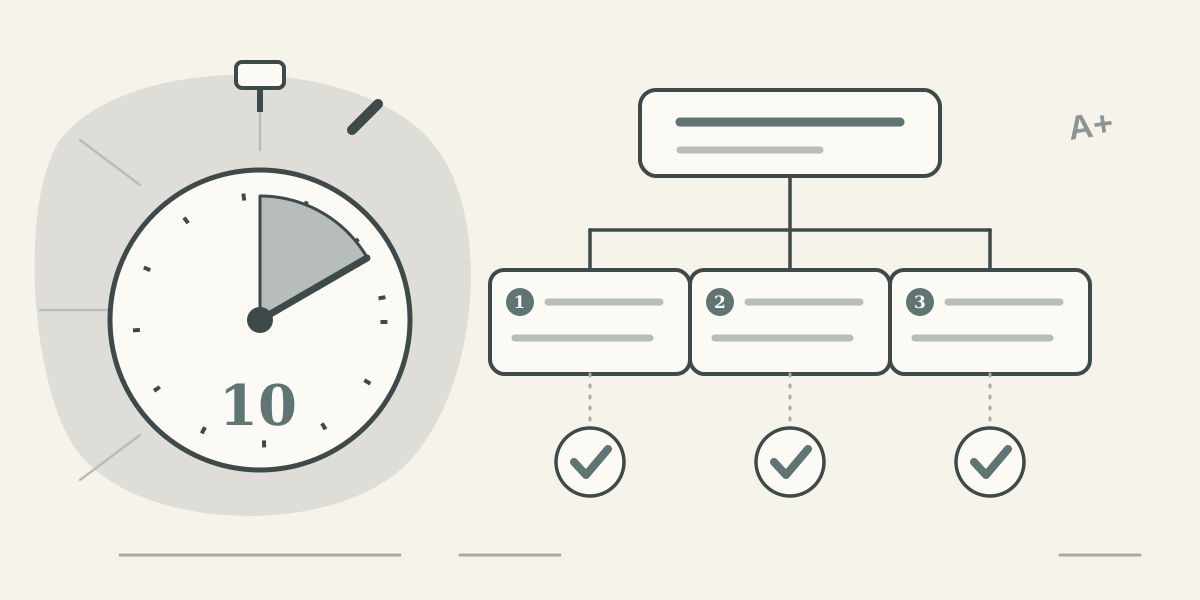
You choose your question. You look at the clock. Ninety minutes feels short, and the urge is to start writing at once. Plan, the voice in your head says, is for people with time to spare.
That instinct costs marks. Students who skip planning tend to write an essay that drifts, repeats itself, or answers a slightly different question than the one asked. They run out of ideas halfway and then pad the middle with whatever comes to mind.
A short, structured plan fixes all three problems. This guide gives you a ten-minute routine, a template you can copy onto your answer booklet, and a worked example.
Why ten minutes is worth it
Paper 1 gives you 90 minutes for one essay of roughly 500 to 800 words. Spending around ten minutes planning leaves about 70 minutes to write and a few minutes to check. For a full pacing breakdown across the paper, see our guide on time management in essay exams.
A plan buys you three things:
- A clear stance. You know your answer before you write the first sentence.
- Controlled content. Each paragraph has a job, so you avoid repeating yourself.
- Confidence under pressure. If you lose your place, the plan tells you where you are.
The 10-minute routine
| Minutes | Step | Output |
|---|---|---|
| 0 to 2 | Analyse the question | Keywords, scope, type of question |
| 2 to 4 | Decide your stance | One-line thesis |
| 4 to 8 | Build 3 arguments with evidence | Point plus example for each |
| 8 to 10 | Sketch intro and conclusion | Hook idea and final thought |
Minutes 0 to 2: analyse the question
Underline the keywords and note exactly what the question asks. Ask yourself:
- What is the topic? (the main subject)
- What is the scope? (a place, a group, a time period)
- What is the instruction? ("to what extent," "should," "is it true that")
Misreading scope is a common way to go off-topic. If the question says "in your society," your examples must be anchored there. For a deeper method, see our guide to GP essay question analysis.
Minutes 2 to 4: write your thesis in one line
Decide your answer now and write it as a single sentence. A good thesis is specific and contestable. It also gives you a direction, so you can see which arguments support it.
Weak: "Social media has both good and bad effects."
Better: "Social media has made people more connected but less informed, because its design rewards speed and emotion over accuracy."
If you cannot write a thesis in a sentence, you have not decided yet. Pause and decide before moving on.
Minutes 4 to 8: build three arguments with evidence
For each argument, jot down a point (one line) and an example (one line). Aim for three, which is enough for most essays and is manageable in the time.
A quick test for each argument: does it directly support my thesis, and could I explain why? If you cannot, replace it.
Choose examples that are specific. A named policy, event, study or trend is stronger than "many people." If you maintain a content bank, this is the moment to draw on it. Our guide on global examples beyond Singapore helps you build one.
Minutes 8 to 10: sketch the introduction and conclusion
You do not need full sentences. Write a few words for:
- Hook: a quotation, statistic or scenario
- Context and thesis: a note to restate your stance
- Final thought: where your argument leaves the reader
Fixing your closing idea now helps you write towards it. For more on endings, see our guide to writing a GP essay conclusion.
A plan template you can copy
Copy this skeleton onto your booklet or scrap paper:
Q: [keywords + scope + instruction]
Thesis: [one sentence]

Para 1  Point:    Example:
Para 2  Point:    Example:
Para 3  Counter + rebuttal:   Example:

Intro hook:
Final thought:
Notice that the third paragraph is set aside for a counter-argument and its rebuttal. Many GP questions reward balance, and putting it into your plan means you do not forget it. Our guide on writing a counter-argument and rebuttal shows how.
A worked example
Question: To what extent has technology made people less able to think for themselves?
Analysis: Topic is technology and independent thinking. Scope is people in general. Instruction is "to what extent," so I need a qualified answer.
Thesis: Technology has weakened independent thinking only where people let it replace effort, not where they use it to extend it.
| Para | Point | Example |
|---|---|---|
| 1 | Instant answers reduce the habit of struggling with a problem | Students who rely on search results rather than reasoning |
| 2 | Algorithmic feeds narrow what people encounter | Recommendation systems that reinforce existing views |
| 3 | Counter: technology widens access to ideas; rebuttal: access only helps those who engage critically | Online courses and open libraries |
Intro hook: A scene of a student reaching for a phone before thinking. Final thought: The scarce skill will be deciding which questions are worth asking.
That took about ten minutes, and the essay already has a spine.
Common planning mistakes
- Planning in full sentences. Notes are enough. Full sentences waste time.
- Choosing a thesis that is only a topic. "Technology is important" is not a stance.
- Having five weak arguments. Three developed arguments beat five thin ones.
- Forgetting the counter-argument. Reserve a slot in the plan.
- Not revisiting the plan. Glance at it between paragraphs to stay on track.
Key takeaways
- Spend about 10 of your 90 minutes planning; it saves more than it costs.
- Analyse the question, fix a one-line thesis, build three argument-and-example pairs, then sketch the introduction and conclusion.
- Write notes, not sentences.
- Reserve one paragraph for a counter-argument and rebuttal.
- Use the plan as a map while you write.
See how your essays measure up
Get detailed feedback on your A-Level essays in under 45 seconds. Free to start — no credit card required.
Frequently Asked Questions
How long should I spend planning a GP essay?
Around 10 minutes of the 90-minute paper is a reasonable guide. This leaves roughly 70 minutes to write and a few minutes to proofread. Adjust slightly depending on how quickly you write.
How many arguments should a GP essay have?
Most students do well with three developed arguments, including a counter-argument and rebuttal. Depth matters more than the number of points.
Should I write a full outline or just notes?
Notes are enough. Write the thesis as a full sentence, and everything else in a few words each. The plan is a map for you, not a draft for the examiner.
What if I change my mind while writing?
Small changes are fine, but make sure your thesis, body and conclusion still agree with each other. If your view shifts a lot, quickly update the thesis in your plan before continuing.
Ready to put these tips into practice?
Submit your essay and get examiner-grade AO feedback in 90 seconds.
Related articles

How to Write a Counter-Argument and Rebuttal in a GP Essay
Balanced GP essays win marks, but a weak counter-argument can undo your thesis. Learn the concession-rebuttal method with sentence stems, a worked paragraph and common mistakes.

How to Write a GP Essay Conclusion (With Examples)
The GP band descriptors grade your conclusion directly. Learn the 4-part structure, 5 techniques, and before-and-after examples for a Band 5 GP essay conclusion.
GP Essay Opening Sentences That Impress Examiners: 10 Techniques for A-Level Success
Master the art of writing compelling GP essay introductions with these 10 examiner-approved techniques, complete with topic-specific examples for A-Level success.